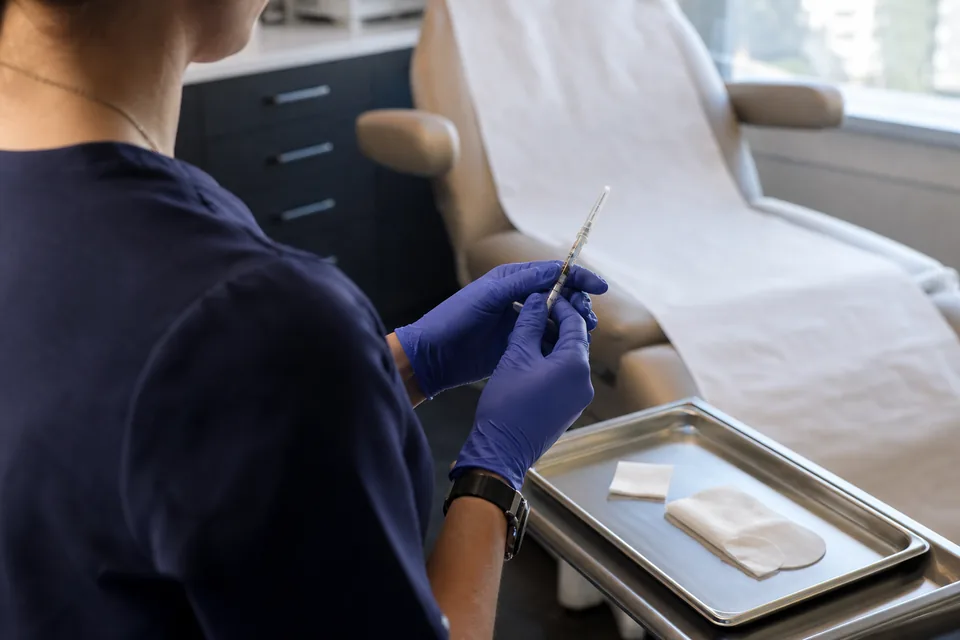
What dermal fillers are
Most fillers used today are based on hyaluronic acid, a substance that occurs naturally in the skin and holds water. Hyaluronic acid fillers come in softer and firmer versions. Softer gels are often used where the tissue moves a lot, such as the lips, while firmer gels are often used where structure is the goal, such as the cheeks or the jawline. There are also biostimulatory fillers that work differently, by encouraging the body to build its own collagen over time. Ask which type you are being offered, because the answer changes how long it lasts and whether it can be dissolved.
General ranges by area
These are broad patterns commonly described by providers. Your own result may be shorter or longer.
- Lips. The lips move constantly, so filler there often lasts the shortest time, commonly described as several months to around a year.
- Cheeks. Firmer gels in an area with less movement often last longer, commonly around a year or more for many people.
- Under the eyes. Results in this area are often described as lasting a long time for some people, though the area is delicate and needs an experienced provider.
- Jawline and chin. Structural fillers here are often described as lasting around a year or longer.
- Smile lines. Filler around the mouth is in a moving area and is commonly described as lasting several months to a year.
Why filler settles
Filler often looks different in the first days than it will later, and that is expected. Right after treatment, swelling adds volume of its own, especially in the lips. Bruising can also make the area look uneven. Over roughly the first two weeks, swelling subsides and the gel integrates with the surrounding tissue. Hyaluronic acid also draws in some water, which can change how full the area looks over the first days. This is why many providers ask you to wait about two weeks before judging the result, and why follow-up visits are often scheduled around that time.
Why filler fades
The body breaks down hyaluronic acid naturally, and filler is no exception. The process is gradual, so most people notice a slow softening rather than a sudden change. Some people find that filler seems to last longer with repeated treatments, and some imaging research suggests that traces of filler can remain longer than the visible effect. That is one more reason to share your full treatment history with any new provider.
What affects how long it lasts
- The product. Different gels are designed to last different lengths of time.
- The area. More movement usually means a shorter result.
- The amount and the plan. Your provider decides what is appropriate for your face.
- Your body. Metabolism varies, and some people break filler down faster than others.
- Lifestyle. Strong sun exposure and smoking affect the skin in general and may affect how results look over time.
Can filler be reversed
Hyaluronic acid filler can usually be dissolved by a provider with an enzyme if there is a problem or you are unhappy with the result. Biostimulatory fillers cannot be dissolved this way. This is one of the most important questions to ask before treatment.
Filler and neuromodulators are different
Filler adds volume or structure. Neuromodulators such as Botox relax muscles that cause expression lines. Many people have both kinds of concern. Compare the two in Botox vs filler, and read how long does Botox last for neuromodulator timing.
Reasons a provider may say no or ask you to wait
A provider may decline or delay treatment during pregnancy or breastfeeding, with an active skin infection or cold sore in the area, with certain medications such as blood thinners, or with certain autoimmune conditions. Ask a licensed provider.
Questions to ask your provider
- Which filler are you suggesting, and why for this area?
- Is it hyaluronic acid, and can it be dissolved if needed?
- How long does it usually last in this area for people like me?
- What will swelling look like, and when should I judge the result?
- Is a follow-up visit included?
- How do you quote price for this treatment?
What it costs
Price varies by clinic, ask for a quote. Quotes depend on the product, the area, the amount your provider plans, their training and your city. Read more on lip filler cost.
General information, not medical advice. A licensed provider decides whether a treatment is right for you.
Performed by licensed medical professionals. Who may perform it depends on your state's rules.